When you step into the Junior School STEM room, you will see more cardboard than chrome. Students are sketching on flip-top desks, building prototypes from recycled materials and explaining why their designs work, or why they do not. At the centre of it all is David Perfect, whose approach to STEM is less about technology itself and more about the thinking that surrounds it.
Dave joined Burgmann in 2011 and has spent more than a decade shaping learning that sparks curiosity, creativity and critical thinking. After teaching Years 4 and 5, his fascination with flexible learning and hands-on problem solving led him to create Burgmann’s Junior School STEM program in 2019. Since then, he has been helping students from Kindergarten to Year 5 learn how to think differently.
“STEM is not about the robots,” Dave says. “It is about slowing down, asking questions and looking at problems in new ways.” He describes it as a framework for thinking that brings together design thinking, computational thinking and the scientific method. In practice, this means students empathise with a user, define the problem, ideate, prototype and test. It is a process that values imagination and iteration more than perfection.
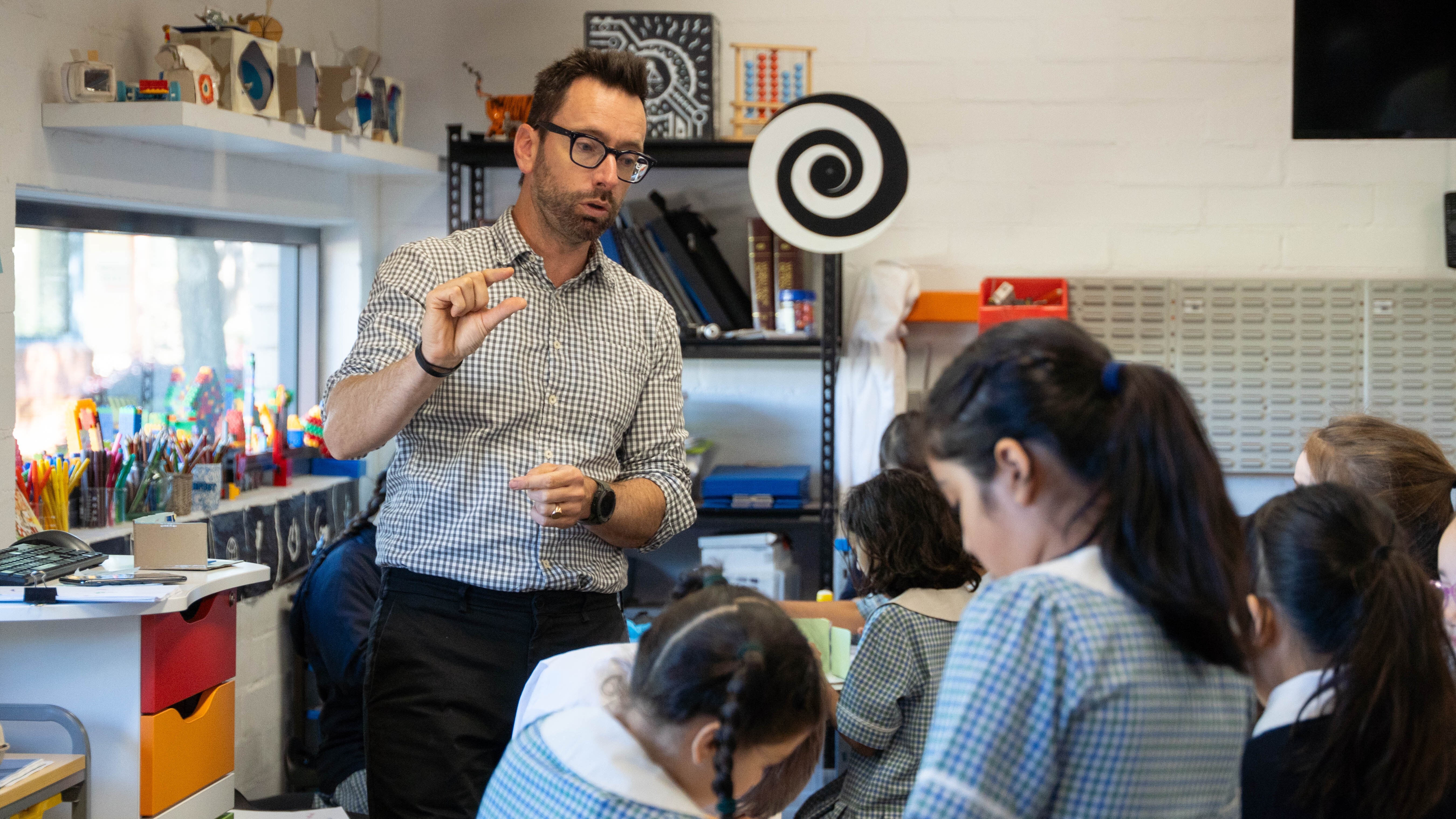
Technology is a powerful tool, but only when it is used with purpose. “An iPad is not a gaming device,” he reminds students. “It is a toolbox for creating something that did not exist before.” His classroom approach is as much about stepping away from screens as it is about using them well. “When students learn without technology, they often return to it with better ideas,” he says.
The result is a learning space that hums with energy and ideas. Dave calls it “messy learning”, busy and noisy, filled with discovery. Students design sustainable rooms, build working catapults or take apart real devices to see how they function. They learn to think like engineers, designers and collaborators long before they know those words apply to them.
The impact of this approach is visible across the school. Some of Dave’s former students, now in Senior School, volunteer in lunchtime STEM clubs where they mentor younger learners in coding and design. “That is the best part,” he says. “Seeing that spark continue, it tells me this way of learning sticks.”

For Dave, curiosity is the real measure of success. “Be curious, make mistakes, have fun and never stop learning,” he says. “That is what I want them to take with them.”
At Burgmann, that spirit of curiosity does more than shape the early years. It is the same energy that carries students through to Year 12 and beyond, creating a foundation for confidence, creativity and genuine excellence.
This article appeared in the Summer 2025/26 Edition of The Gribble.